
In this article
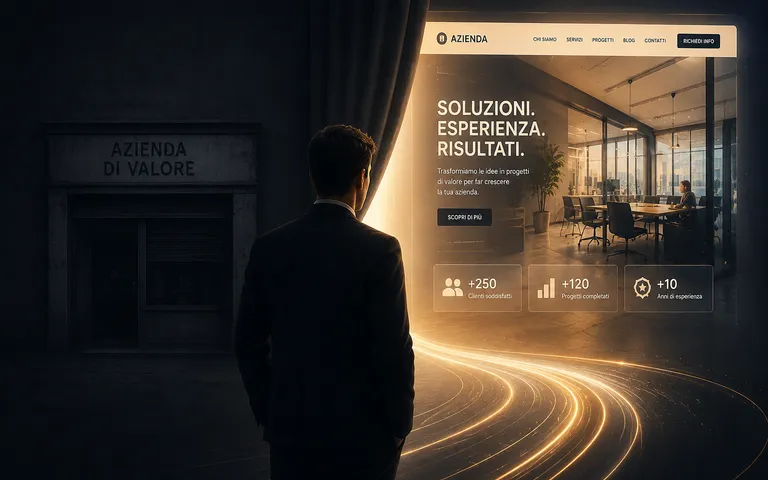
There are companies that have been working well for years. They have loyal customers, solid expertise, valuable products and a reputation built through real work. Yet, when you look at them online, they appear smaller, less structured or less authoritative than they actually are.
This is one of the most underestimated problems for many Italian SMEs: not being absent from digital channels, but being present in the wrong way.
The website exists, but it does not truly tell the company’s story. The content is there, but it feels generic. The images do not highlight products, people or spaces properly. The pages are unclear. The communication feels outdated. The company’s real strengths do not emerge.
The result is simple: the company continues to have strong value offline, but online it communicates less than it is worth.
The first judgment happens before contact
In the past, customers discovered a company through word of mouth, a visit, a phone call or a direct relationship. Today, even when word of mouth still exists, people almost always run an online check first.
They search for the website, look at reviews, check the photos, read what the company does, evaluate whether it feels up to date and compare its presence with competitors.
This judgment happens in just a few seconds.
It is not always rational, but it matters. An old, slow, confusing or poorly maintained website does not communicate only an aesthetic issue. It also communicates, even unintentionally, a lack of attention, poor organization or distance from the customer.
The company may be excellent. But if it does not show that online, the customer does not know.
The problem is not “having a nice website”
Many businesses think the issue is simply redesigning the website to make it look more modern. But the point is not only aesthetic.
An effective website should not just look good. It should make it clear what the company does, why it is different, who it serves, what problems it solves and what value it brings.
Design matters, but strategy comes first.
A website can be visually pleasant and still fail to convert. It can have beautiful images but weak copy. It can include modern animations but lack a clear hierarchy. It can have many pages but no path designed to guide the customer.
The real goal is not to look more digital. It is to appear more credible, clearer and closer to the customer’s needs.
When digital does not reflect real value
The problem often comes from a gap between what the company is and what it communicates.
A business may have excellent customer service, but never mention it online. It may offer high-quality products, but show them through weak images. It may have years of experience, but fail to highlight them. It may have a precise method, but not explain it. It may have real cases, satisfied customers and results, but never make them visible.
This creates a paradox: companies that are less prepared, but better at presenting themselves, appear stronger than companies that are truly solid but digitally invisible.
And in a market where customers compare everything quickly, perception becomes part of value.
Trust is built through details
Online, trust is built through many small signals.
An organized website, a clear services page, consistent visuals, well-written texts, easy-to-find contacts, highlighted reviews, fast response times, a good mobile experience and updated information.
None of these elements, on their own, completely changes the perception of a company. But together, they create a precise feeling: this business is serious, organized and attentive.
This is exactly what is often missing.
Not because the company is not valuable, but because it has never designed its digital presence as a system of trust.
Being online is not enough: you need to be clear
Another common mistake is assuming that customers have time to understand.
In reality, online customers do not study a company patiently. They scan, compare and interpret.
If they do not immediately understand what you do, they leave. If they cannot find contact information, they leave. If they do not perceive a difference, they compare only on price. If the website feels neglected, they doubt. If the path is confusing, they postpone the decision.
That is why clarity is a competitive advantage.
A good digital project removes friction. It makes it easy to understand, trust and get in touch. It guides the visitor without forcing them to search for hidden information.
Simplicity, when well designed, does not reduce value. It makes value more accessible.
The website is only one part of digital identity
A company’s online presence does not end with the website.
It matters how the company appears on Google. It matters how it responds to reviews. It matters what it communicates on social media. It matters how good its emails are. It matters whether the visuals are consistent. It matters how products and services are presented. It matters how quickly the company responds to a request. It also matters what happens after the first contact.
Customers do not see separate tools. They see one single experience.
If the website is polished but email communication is confusing, something breaks. If social media is updated but the website is outdated, something feels inconsistent. If the product is premium but the images are weak, the perceived value drops. If the company promises attention but the contact form does not receive a response, trust decreases.
Digital identity is not a graphic element. It is the way the company is perceived across every touchpoint.
The right question
When a company decides to improve its online presence, the question should not only be: “Do we need to redesign the website?”
The right question is: “Does our digital presence truly represent the value we have?”
Because a website, a Google profile, a social media page or even a simple commercial email are not just communication tools. They are signals. They tell the customer how organized the company is, how reliable it feels, how clear the offer is and how easy it is to get in touch.
If these signals are weak, confused or inconsistent, even a solid company risks appearing less prepared than it really is.
And this is not just an image problem. It is a commercial problem.
Because every unconvincing online visit is a possible lost opportunity.
Conclusion
Many SMEs do not need to invent a new identity. They need to make visible the one they already have.
The value is there, but it needs to be communicated better. The experience is there, but it needs to be made clearer. The quality is there, but it needs to be shown. The trust is there, but it needs to be built online too.
Today, being good is not enough if digital channels do not communicate it.
A company that looks smaller online than it really is risks losing authority, contacts and opportunities. Not because it has no value, but because that value does not reach the customer at the moment it is being evaluated.
The point is not to appear bigger.
The point is to finally communicate the real dimension of the company.

I am a Computer Engineering graduate at Politecnico di Torino with a strong interest in photography, computer science, and video editing. In 2021, I founded PRODHERO, specializing in high-quality video and photo content for businesses, shops, and individuals. Later, I expanded into the tech space, delivering web apps, automation, and custom AI solutions through CLOUDYNAMICS. With a focus on both storytelling and technology, we help clients grow their presence and scale their operations. I am passionate about combining creative vision with technical precision to deliver results that actually matter.