
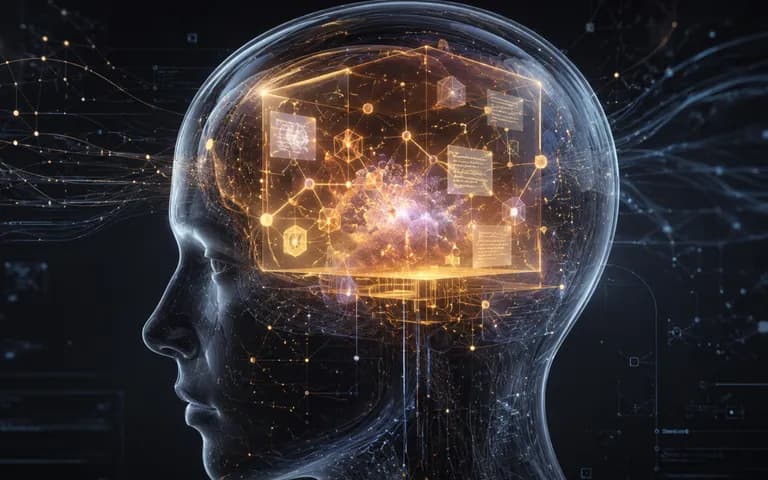
For years, we have looked at artificial intelligence models from the outside. We write a question, wait a few seconds, and read an answer. What happens in between, however, remains largely invisible.
It is precisely this hidden part that makes large language models so fascinating and, at the same time, so difficult to interpret. We know they generate text. We know they can solve problems, write code, summarize documents and answer complex questions. But truly understanding what happens inside the model while it does so is another matter.
A recent study by Anthropic tries to open a small window into this internal space. The research, titled “Verbalizable Representations Form a Global Workspace in Language Models”, introduces the concept of J-Space: an internal area of the model where certain representations seem to become available to be expressed, used in reasoning and recalled during processing.
Put simply, the model may have a kind of internal “workspace” where some concepts remain active before the final answer is generated.
But this does not mean that AI is conscious.
What J-Space is
The term J-Space comes from the technique used by the researchers, called Jacobian lens, or J-lens. This technique attempts to identify which internal representations the model is “ready” to verbalize at a given moment, meaning which concepts could emerge in the answer if the model were prompted or directed in a certain way.
We are not talking about thoughts in the human sense of the word. There is no proof of subjective experience, intention or awareness. Rather, J-Space appears to be a part of the model’s internal representations that works like a temporary whiteboard: some concepts are written down, maintained, combined and then used to generate a response.
The interesting part is that these internal contents do not always appear in the final text. A model may process an intermediate step, recognize a problem, suspect that a source is false or keep a concept active without explicitly stating it in the response.
In this sense, J-Space becomes a practical window into part of the model’s “unspoken processing”.
Why it is compared to a “global workspace”
In the study, Anthropic connects J-Space to Global Workspace Theory, a theory used in cognitive neuroscience to explain how certain information becomes available to consciousness, language and deliberate control.
According to this idea, the brain processes a huge amount of information, but only a small part becomes accessible at a more general level, where it can be used for reasoning, speech or decision-making.
The comparison should not be pushed too far.
Saying that a model has something that functionally resembles a “workspace” does not mean saying it is conscious like a person. It means that, from a functional point of view, some internal information seems to play a special role: it can be reported, used across different tasks, maintained for several steps and distributed to other parts of the model.
It is as if, inside the model, not all information has the same weight. Some remains more automatic and is used for basic tasks such as grammar, fluency or simple associations. Other information enters a more central space, where it becomes useful for more flexible reasoning.
AI does not “think” like us, but it is not just autocomplete either
For a long time, language models were described as simple autocomplete systems: they take the previous text and predict the next word.
Technically, this description has a real basis. But it is too limited to explain what the most advanced models are able to do.
A large language model does not reason like a human being. It does not have a biography, a body, emotions, personal intentions or lived experience of the world. However, during computation, it builds complex internal representations. These representations can contain relationships, concepts, intermediate steps, hypotheses and information that are not immediately visible in the final output.
J-Space is interesting precisely because it shows that part of these representations can be studied. We do not see the model’s “mind”, but we can begin to observe which concepts become available to be said or used.
It is a subtle difference, but an important one.
It is not magic.
It is not consciousness.
It is interpretability.
Why this discovery matters
Research on J-Space matters because it helps address one of the biggest problems in modern artificial intelligence: the black box.
Models are becoming more powerful, but we often cannot explain exactly why they produce a certain answer. This becomes even more important when AI is used for complex tasks such as analysis, coding, research, assistance, decision support or evaluation.
If we could better understand which concepts a model is keeping active, we could develop better tools to understand when it is reasoning correctly, detect errors before they appear in the final answer, identify inconsistencies, study unwanted behaviors and improve model safety.
J-Space is therefore interesting not only for scientific research, but also for the future of AI safety and control.
The risk of the easy headline: “AI is conscious”
The problem, as often happens, is that a technical discovery can easily be turned into an exaggerated headline.
“Claude has hidden thoughts.”
“AI is conscious.”
“Machines are starting to think.”
These phrases attract attention, but they do not describe the issue accurately.
J-Space does not prove that a model feels anything. It does not prove that it has desires, intentions or subjective awareness. Instead, it shows that some models may have internal representations that are more structured, accessible and functional than previously assumed.
The difference is essential.
Studying J-Space does not mean looking for the soul of AI. It means building better tools to understand systems that are becoming increasingly powerful and increasingly difficult to interpret.
The real question
The most interesting question is not: “Does AI think like us?”
Probably not.
The more useful question is: “How much can we understand about what a model processes before answering us?”
J-Space does not close the debate. It opens it.
It reminds us that language models are not simple text boxes, but complex systems with internal representations that can be studied, interpreted and perhaps, in the future, controlled more effectively.
And perhaps this is the most fascinating part: not saying that AI is human, but understanding how different it has become from any technology we have used before.

I am a Computer Engineering graduate at Politecnico di Torino with a strong interest in photography, computer science, and video editing. In 2021, I founded PRODHERO, specializing in high-quality video and photo content for businesses, shops, and individuals. Later, I expanded into the tech space, delivering web apps, automation, and custom AI solutions through CLOUDYNAMICS. With a focus on both storytelling and technology, we help clients grow their presence and scale their operations. I am passionate about combining creative vision with technical precision to deliver results that actually matter.